Popular Post
K-offset: The “Time-Travel” Fix for 5G NTN
If you’ve ever wondered how a 5G phone can talk to a satellite 500 km above Earth, the answer is all about timing.
In normal (terrestrial) 5G networks:
- Signals travel short distances
- So timing is predictable and fast
But in satellite networks (NTN):
- Signals have to travel very long distances
- This causes big delays (called propagation delay)
👉 This delay can confuse the network and break communication timing.
The Fix: K-offset
K-offset is a smart solution introduced in 3GPP Release 17.
It works like this:
- The network intentionally adds extra time (a buffer)
- This gives signals enough time to travel to and from the satellite
- So everything stays properly synchronized.
🤔 The Problem: The “Canyon Echo” Effect
In normal terrestrial 5G, the distance between your phone and the cell tower is small. The network uses fixed timing rules, known as K-values, to schedule things:
- K1: The time between the phone receiving data (PDSCH) and sending an Acknowledgment (HARQ-ACK). Usually just a few slots (~0.5 milliseconds).
- K2: The time between the network granting permission to speak (UL Grant) and the phone actually transmitting (PUSCH).
The NTN Disaster Scenario:
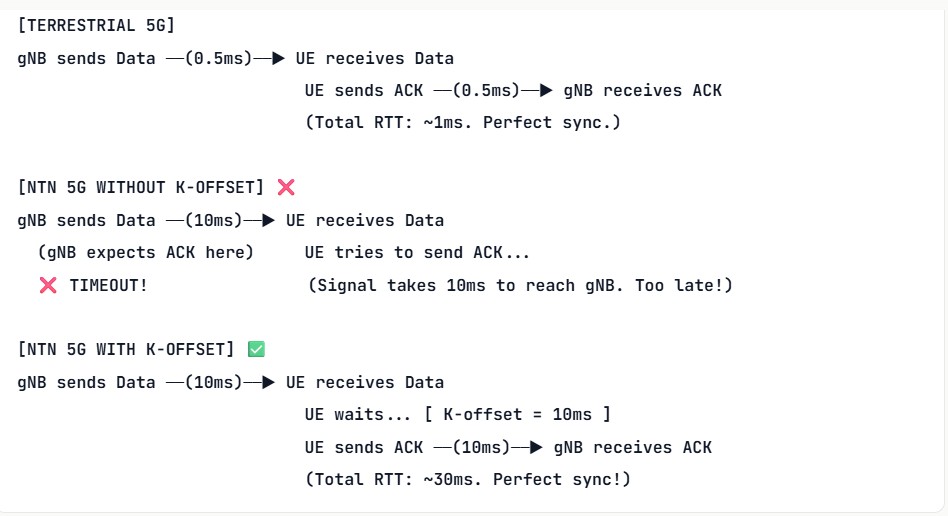
Imagine a LEO (Low Earth Orbit) satellite with a Round-Trip Time (RTT) of 20 milliseconds. If the gNB (base station) uses the standard terrestrial K1 value of 0.5ms, it will expect the phone’s acknowledgment 20 milliseconds before the phone even received the original message!
The network would constantly time out, assume the connection failed, and drop the call.
💡 The Solution: What is K-offset?
K-offset is essentially a “buffer time” or a “delay offset” broadcast by the satellite to the UE (User Equipment).
Instead of rewriting the entire 5G scheduling rulebook for space, 3GPP simply added K-offset to the existing K1 and K2 values. It tells the UE: “Take the standard timing rule, and add this extra delay to account for the trip to space and back.”
The Simple Formula:
Actual UL Transmission Time = DL Reception Time + Standard K-value (K1/K2) + K-offset
By adding K-offset, the UE intentionally delays its response. This ensures that when the UE finally transmits, the signal arrives at the satellite exactly when the gNB is listening for it.
How is K-offset Configured?
- Broadcast: The satellite includes the
k_Offsetparameter inside SIB19 (System Information Block 19) or provides it via dedicated RRC signaling during connection setup. - Dynamic Adjustment: As a LEO satellite moves across the sky, the distance to the UE changes. The propagation delay changes. Therefore, the network can update the K-offset value dynamically to keep the timing perfectly aligned.
- MAC Layer Patience: K-offset works hand-in-hand with another NTN parameter called K_MAC (which we covered in our SIB19 deep dive). While K-offset delays the start of the UE’s transmission, K_MAC tells the UE’s MAC layer to be “patient” and wait longer for the gNB’s response.
June 13, 2026