Popular Post
📡 SIB19: The Brain of 5G NTN Connectivity.
In terrestrial 5G, the distance between a UE (smartphone) and the cell tower is negligible (a few kilometers). Signal delay is ~1ms, and Doppler shift is virtually zero.
In Non-Terrestrial Networks (NTN), the “tower” is a satellite hundreds or thousands of kilometers away. This introduces two massive problems: huge propagation delays (up to 30ms for LEO, 500ms+ for GEO) and extreme Doppler shifts due to satellite movement.
Enter SIB19 (System Information Block Type 19). Introduced in 3GPP Release 17, SIB19 is the specialized broadcast message that gives the UE all the mathematical and timing data it needs to “aim” its signal correctly at a moving satellite. Without SIB19, NTN random access would fail 100% of the time.
SIB19 Information Elements (IEs).
SIB19 contains the NTN-Config IE. Here is a plain-English breakdown of every critical parameter inside it:
1. epoch (The Reference Time)
- What it is: A specific System Frame Number (SFN) and subframe that acts as “Time Zero.”
- Why it matters: All orbital calculations and timing drifts are relative to this exact moment. It’s like setting a synchronized stopwatch for both the satellite and the UE.
2. orbitModel (The Satellite’s GPS)
- What it is: The mathematical model defining the satellite’s path. It comes in two flavors:
keplerianParameters: A compact set of 6-7 numbers (semi-major axis, eccentricity, inclination, etc.) that the UE’s processor uses to calculate the satellite’s 3D position. Highly efficient for LEO/MEO.ephemerisModel: Used for complex orbits (like GEO with station-keeping wobbles) where simple math isn’t enough.
- Why it matters: Instead of broadcasting massive, continuous GPS-like data, the network sends a formula. The UE calculates the satellite’s location itself, saving precious broadcast bandwidth.
3. ephemerisInfo (The Backup Data)
- What it is: If the orbit is too complex for
keplerianParameters, this IE provides the actual ephemeris data. ephemerisReference: If the data is too large for a broadcast message, this provides a URL (e.g., via HTTP/HTTPS) where the UE can download the precise satellite position file.
4. commonBeamInfo (The Spotlight)
- What it is: Contains the
beamIdand thereferencePoint(latitude/longitude) of the center of the satellite’s beam footprint on Earth. - Why it matters: Helps the UE confirm it is actually inside the intended coverage area before attempting to connect.
5. serviceLinkInfo (The Radio Rules)
- What it is: Defines the
dl-CarrierFreqandul-CarrierFreq. Crucially, it includesdopplerPreCompensation(a boolean: true/false). - Why it matters: If
true, the network (satellite/gNB) is already adjusting the downlink frequency to cancel out Doppler. Iffalse, the UE must calculate and pre-compensate its own uplink frequency before transmitting.
6. ta-Info (The Timing Advance Package)
Because the distance is huge, the UE must transmit early so the signal arrives at the satellite in the correct time slot. This IE provides a 3-part prediction:
ta-Common: The baseline round-trip delay to the satellite’s reference point.ta-CommonDrift: The rate at which this delay is changing (velocity). Essential for LEO satellites moving at 7.5 km/s.ta-CommonDriftVariant: The acceleration of that delay change (the second derivative). Ensures pinpoint accuracy as the satellite passes overhead.
7. k_Mac (The HARQ Patience Parameter)
- What it is: An integer value (in milliseconds or subframes).
- Why it matters: In normal 5G, the UE expects an ACK/NACK for its data in ~3-4ms. In NTN, the signal might take 15ms just to reach the satellite.
k_Mactells the UE’s MAC layer: “Do not assume the transmission failed; wait this long for the response.”
8. ntn-PagingCycle (The Battery Saver)
- What it is: Extended paging cycles (e.g.,
rf640,rf1280,rf2560). - Why it matters: Because the satellite beam sweeps across the Earth, a UE might only be in coverage for a short window. Extended cycles prevent the UE from waking up unnecessarily and draining its battery while waiting for a page that won’t come until the beam returns.
9. earthCoverageInfo (The Geo-Fence)
- What it is: A polygon of latitude/longitude coordinates defining the exact valid footprint of the cell.
- Why it matters: Prevents UEs outside the beam (e.g., in an adjacent country or ocean) from wasting power trying to decode signals or initiate random access.
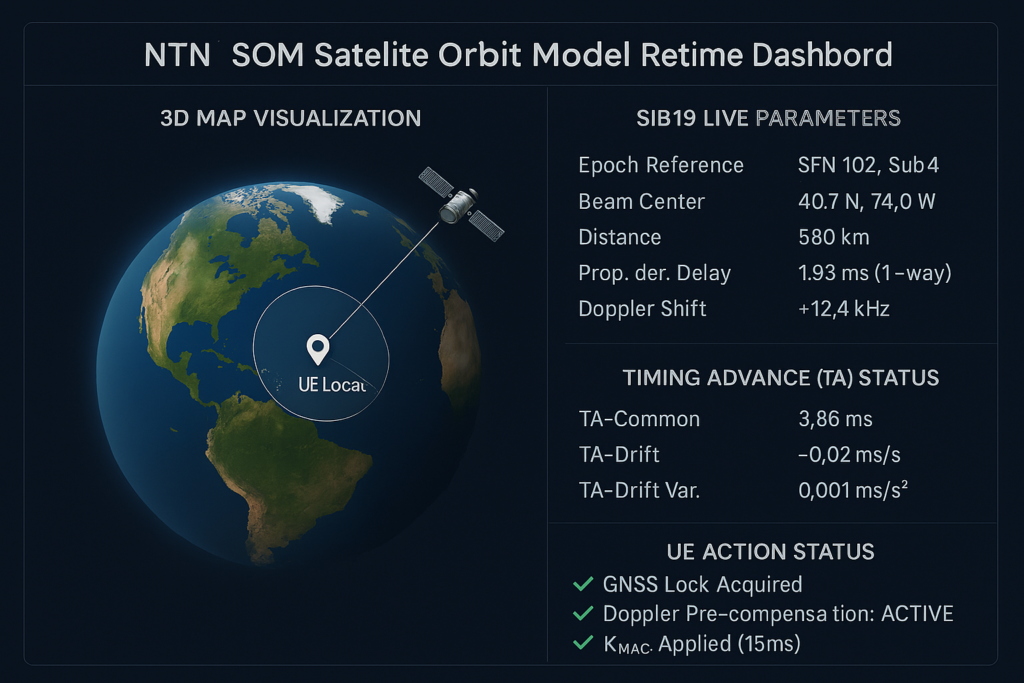
NTN SIB19 Signaling Flow (Step-by-Step)
Here is the exact sequence of events from the moment a UE powers on in a remote area to successfully connecting via satellite.
-
System Broadcast (gNB ➔ UE)
The satellite broadcasts the MIB, followed by SIB1. SIB1 contains the scheduling information indicating that SIB19 is present in this cell. -
SIB19 Acquisition (UE ➔ Internal)
The UE reads SIB19 and extracts theNTN-Config(Epoch, Orbit Model, TA-Info, K_MAC, etc.). -
GNSS Self-Location (UE ➔ Internal)
The UE activates its GNSS receiver (GPS/Galileo) to determine its own precise latitude, longitude, and altitude. (Note: NTN UEs must be GNSS-capable). -
The NTN Math Engine (UE ➔ Internal)
The UE combines its own GNSS location with the SIB19orbitModelandepoch. It calculates:- Exact 3D distance to the satellite.
- Current propagation delay.
- Relative velocity (to determine Doppler shift).
-
Pre-Compensation (UE ➔ Internal)
Before transmitting, the UE adjusts its local oscillator (to counter Doppler) and advances its transmission clock usingta-Common+ta-CommonDrift. -
Random Access Preamble (Msg1) (UE ➔ gNB)
The UE sends the PRACH preamble. Because of Step 5, the signal arrives at the satellite perfectly aligned with the gNB’s expected reception window, despite the hundreds of kilometers of travel. -
Random Access Response (Msg2) (gNB ➔ UE)
The gNB receives Msg1. It measures any residual timing error (because the UE’s calculation might be off by a few microseconds). The gNB sends Msg2 (RAR) containing a fine-tuned MAC CE Timing Advance Command to perfect the alignment. -
Normal 5G Operation (UE ⇄ gNB)
The UE applies the fine-tuned TA, respects thek_Macdelay for HARQ feedback, and proceeds with Msg3 (RRC Setup Request) and normal data transmission.
June 13, 2026
nice explanation