Popular Post
Common Timing Advance (TA) in 5G NTN
The Problem: The “Elevator Pitch” Delay
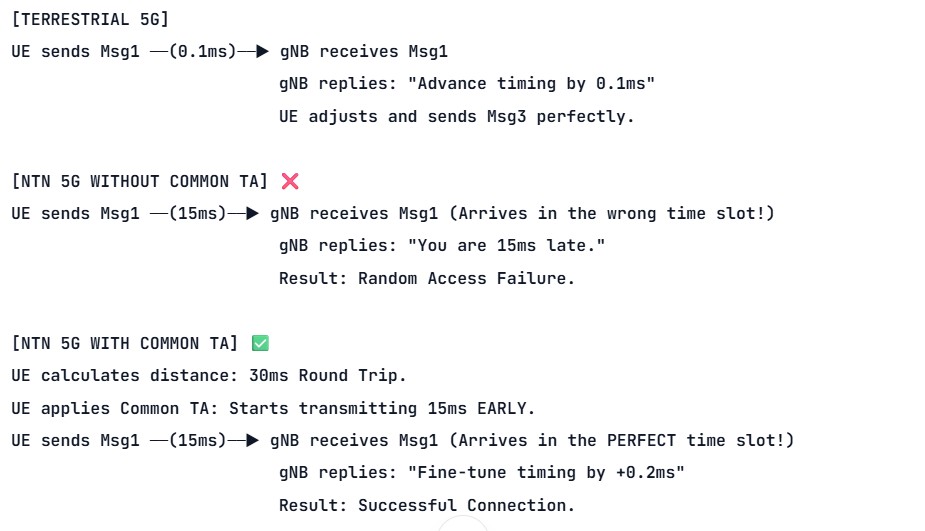
In standard terrestrial 5G, Timing Advance (TA) is a microsecond-level adjustment. The phone sends a random access preamble (Msg1). The cell tower measures how late the signal arrived, calculates the distance, and sends a TA command back to the phone saying, “Transmit 2 microseconds earlier next time.” This happens in a fraction of a millisecond.
In NTN, the distance to the satellite is massive. A signal might take 10 to 15 milliseconds just to travel one way. If the UE waited for the satellite to measure its initial timing and send a correction, the Random Access procedure would take far too long, and the initial signal would likely arrive in the wrong time slot, causing an immediate collision or rejection.
The Solution: Common Timing Advance (Common TA)
To solve this, 3GPP introduced Common TA. Instead of the network guessing the UE’s delay, the UE calculates the baseline delay itself before it even speaks.
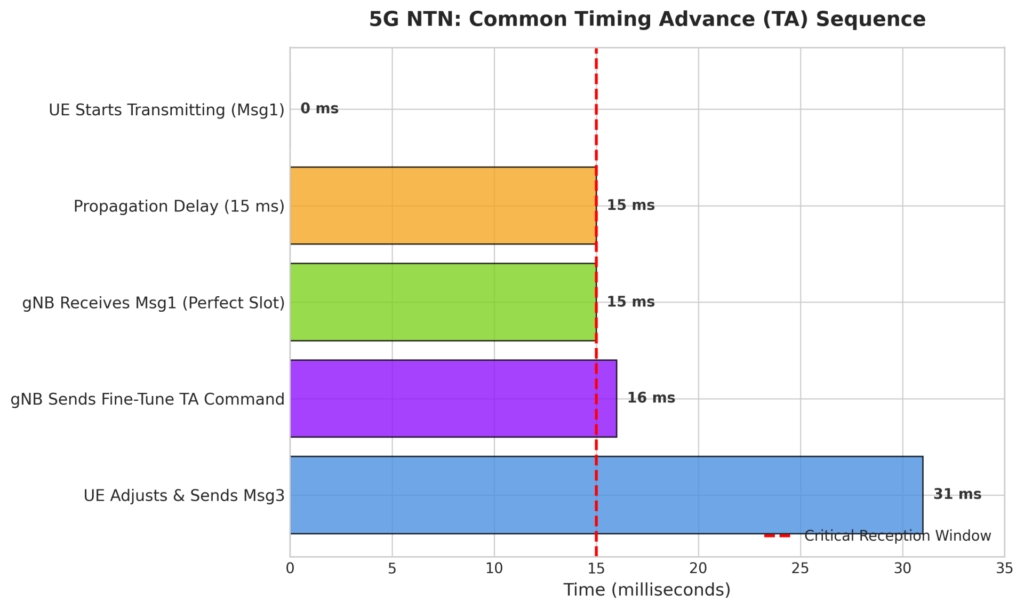
Using its GNSS location and the satellite’s reference point (provided in SIB19), the UE calculates the baseline Round-Trip Time (RTT) to the center of the satellite beam. It then applies this “Common TA” to its very first transmission (Msg1 / PRACH).
The UE essentially says, “I know I am far away, so I am going to start transmitting early so my signal arrives at the satellite at the exact right moment.”
Real-World Analogy: Rough Focus vs. Fine Focus
Imagine using a telescope.
- Common TA is like you turning the large focus knob to get the image “roughly” clear based on your own knowledge of how far away the object is.
- Network TA Command is the observatory expert making a tiny, precise “fine focus” adjustment afterward to make the image perfectly sharp.
Without the rough focus (Common TA), the expert would be looking at a completely blurred image and wouldn’t even know where to start adjusting.
June 13, 2026