Popular Post
What Is NTN in 5G?
Ever had a signal drop the moment you leave town, head offshore, or drive through a mountain pass? NTN in 5G is one of the ways the industry plans to close those dead zones.
NTN stands for Non-Terrestrial Networks. In plain terms, it means 5G that can also travel through satellites or high-altitude platforms (HAPS), not just cell towers on the ground. People search for this because they want coverage where towers can’t go, during emergencies, on ships, in rural areas, or along long highways.
This guide breaks down what 5G NTN is, how it connects your device to the 5G core, where it helps most, and what to expect in real life (including tradeoffs like delay and battery use).
What is NTN in 5G (Non-Terrestrial Networks), in plain words?
5G NTN is 5G expanded into the sky. Instead of relying only on ground towers, the network can use satellites (in orbit) or HAPS (aircraft-like platforms high in the atmosphere) to carry 5G signals.
Think of terrestrial 5G as a road network made of local streets (cell towers). NTN adds bridges over hard terrain, like oceans and deserts. It’s built to extend coverage and keep service available when ground networks struggle, not to replace every cell tower. In cities, towers still win on speed, capacity, and cost.
A basic 5G NTN system has a few key building blocks:
- UE (user equipment): Your phone, hotspot, vehicle modem, or IoT tracker.
- Satellite or HAPS: The “in-the-sky” radio node that talks to your device.
- Gateway (earth station): A ground site that links the space or air network to the operator’s network.
- gNB functions (5G base station): The 5G “cell tower brain,” which may sit on the ground or partly in space, depending on design.
- 5G Core (5GC): The main network that handles identity, routing, voice services, and data sessions.
The point is simple: your device still uses 5G style signaling, it just reaches the network through a non-terrestrial hop when needed.
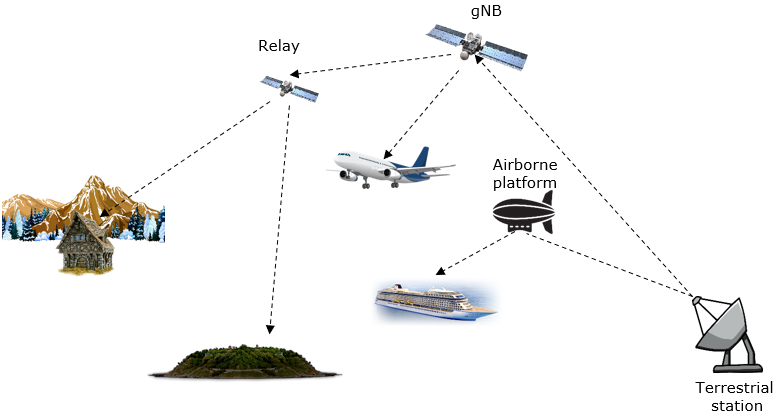
The simple 5G NTN connection path, from your device to the 5G core
A typical connection looks like this:
- Your device connects upward to a satellite or HAPS (this is the service link).
- The satellite or HAPS passes traffic down to a ground gateway (the feeder link).
- The gateway connects into the operator’s 5G core, where calls, texts, and internet traffic are handled.
- Data returns the same way, core to gateway to satellite or HAPS to your device.
Picture a remote highway after a winter storm. Nearby towers may be sparse or damaged. With NTN, a compatible phone or vehicle modem can still send a message, place a basic call, or push location data, even when there’s no usable ground signal.
Transparent vs regenerative satellites, the two main NTN designs
There are two common ways to build the satellite side:
- Transparent (bent-pipe): The satellite mostly acts like a relay, forwarding signals to ground equipment. It can be simpler to deploy, but it depends heavily on gateways and ground processing.
- Regenerative: More of the base station work happens on the satellite itself. This can improve how the system manages capacity and coverage, and in some designs it can work with inter-satellite links. The tradeoff is added complexity and cost.
For most users, the difference shows up as coverage options, performance consistency, and how much the network can do without a nearby gateway.
Why 5G needs NTN: coverage, backup, and new real world use cases
Ground networks are great where people live and work close together. But towers need power, fiber (or microwave backhaul), permits, and ongoing maintenance. In some places, that’s impossible or just too expensive.
NTN fills three big gaps:
Coverage: Oceans, mountains, deserts, and remote roads don’t come with infrastructure. Satellites and HAPS can reach them without building thousands of sites.
Backup connectivity: Fires, floods, and earthquakes can cut fiber and knock out towers. NTN can keep basic links alive for alerts and coordination.
Mobility across wide areas: Ships, planes, and long-haul transport need connectivity while moving through places with limited tower coverage.
The best way to understand 5G NTN is to picture it as an add-on layer. When towers are present, you use them. When they aren’t, NTN can carry the connection.
Top use cases people actually care about (rural, maritime, aviation, disaster response, IoT)
- Rural and remote broadband: Homes, farms, and small communities can get coverage where tower builds don’t pencil out.
- Ships at sea: Crews, navigation systems, and onboard operations can stay connected far from shore.
- Aircraft connectivity: Airlines can use satellite links for in-flight Wi-Fi and operational data, even on long routes.
- Emergency communications after storms: When local networks are down, NTN can support alerts, coordination, and basic contact.
- Tracking for fleets and critical infrastructure: Trucks, rail, pipelines, and remote work sites can send location and status updates outside terrestrial coverage.
- Massive IoT sensors with small bursts of data: Soil sensors, weather stations, and asset tags can transmit small packets without needing nearby towers.
NTN as a backup network when towers fail (resilience and redundancy)
When a region loses power or fiber backhaul, cell towers can go dark or become isolated. NTN gives operators another path. That might mean temporary coverage for first responders, or satellite backhaul that reconnects a hard-to-reach tower to the core network.
For regular people, this can show up as basic texting, emergency calling support, or the ability to send a check-in message when local service is overloaded. It won’t fix every outage, but it can reduce the “no signal anywhere” problem.
Limitations and what to expect from NTN in 2025 and beyond
NTN is improving fast, but it’s not magic. A satellite link has different physics than a short hop to a tower down the street.
Here are the main constraints to keep in mind:
- Latency (delay): Distance matters. Some satellite paths feel slower than terrestrial 5G, which affects real-time apps.
- Moving satellites and Doppler: Many NTN systems use low-Earth orbit (LEO) satellites that move quickly across the sky. Devices and networks must track them and adjust frequency shifts to keep connections stable.
- Device power and antennas: Reaching space can take more power than reaching a nearby tower. Some services work with phones, others need stronger radios or dedicated terminals for higher speeds.
- Operator cost and complexity: Gateways, spectrum coordination, roaming, and capacity planning are hard at global scale.
On standards, 3GPP added NTN support in Release 17, then expanded it in Release 18 (frozen in 2025). Work toward Release 19 continues, with a focus on better mobility handling, timing improvements, and stronger direct-to-device options.
Latency and satellite orbits (GEO vs LEO) explained simply
GEO satellites sit very far away and appear fixed in the sky. The long distance adds noticeable delay (often hundreds of milliseconds round-trip). That can feel sluggish for interactive voice and video, and it’s a poor fit for twitch gaming or tight industrial control loops.
LEO satellites orbit much closer, so delay is lower (often closer to tens of milliseconds, though it varies by path). The tradeoff is you need lots of satellites because each one moves out of view quickly. That means more handovers and more network coordination.
Direct-to-phone vs special terminals: what devices may need
Some NTN services aim for direct-to-phone connections, which is appealing for emergency messaging and basic coverage. But higher speeds, more consistent service, and tougher environments often call for special terminals, better antennas, or vehicle and marine modems.
Battery matters too. If a phone has to transmit harder to reach a satellite, it can drain faster, especially in weak signal conditions. Expect early experiences to focus on essential connectivity first, then expand toward broader data use as networks mature.
December 25, 2025