Popular Post
- SINR
- RSRQ
- RSRP
- 5G: SIB1
- SIB’s in 5G:
- 5G Network Architecture
- 5G(NR): UL Resource allocation
- 5G(NR): Random Access Procedure
- 5G(NR): Frame structure( Slots and symbols Formats)
- 5G NR CORESET
- UE 5G NR Search Space
- 5G_NR_SLIV:
- PDSCH Resource Allocation in Time-Domain
- 5G-NR: MIB
- 5G NR: DCI Formats
- 5G-NR: Carrier Aggregation (CA)
- 5G-NR: Channels
- 5G-NR: SIGNALLING RADIO BEARERS
- 5G NR Bandwidth Part (BWP)
- 5G(NR)-GUTI, SUPI, SUCI
- MSG1 – PRACH in 5G NR:
- What is ARQ and HARQ?
- 5G (NR): DAPS Handover
5G SIB1 – Complete Message-Level Explanation (Simple + 3GPP Aligned)
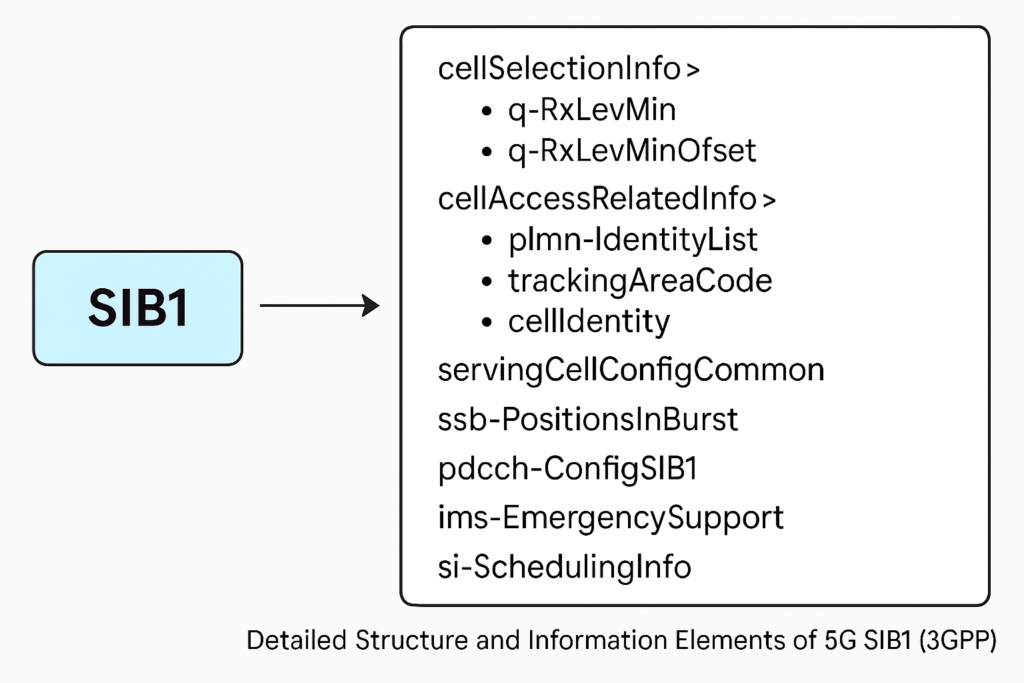
SIB1 (System Information Block Type 1) is the most critical broadcast message in 5G NR.
It gives a UE (User Equipment) the minimum information needed to access a 5G cell.
SIB1 is carried inside:
- BCCH (Broadcast Control Channel)
- Delivered via DL-SCH
- Scheduled through PDCCH using SI-RNTI
Its structure and definitions come from 3GPP TS 38.331.
🧩 High-Level Purpose of SIB1
SIB1 tells the UE:
✔ Who the network is
(PLMN identities, cell identity)
✔ How to access the network
(Access classes, barring, TAC, cell selection thresholds)
✔ How the cell is configured
(Serving cell parameters, SSB positions, PDCCH configurations)
✔ Where other SIBs can be found
(si-SchedulingInfo)
🧱 SIB1 Structure According to 3GPP
Below is the simplified and blog‑friendly structure — still aligned with TS 38.331.
1. cellSelectionInfo
Helps the UE determine if the cell is suitable.
• q-RxLevMin
Minimum required received signal level for camp‑on.
• q-RxLevMinOffset
Adjustment for specific situations (e.g., closed access).
2. cellAccessRelatedInfo
Defines operator identity and where the cell belongs.
• plmn-IdentityList
One or more PLMN IDs
Example: MCC/MNC combinations
• trackingAreaCode (TAC)
Used for mobility & registration management.
• cellIdentity
28-bit NR Cell ID
3. servingCellConfigCommon
Provides the initial common configuration for the UE.
Includes:
- Subcarrier spacing
- SSB periodicity
- PRACH config
- RACH parameters
- UL/DL ConfigCommon
A UE uses this before RRC connection is fully established.
4. ssb-PositionsInBurst
Indicates which SSB beams exist and their bitmap positions.
This is crucial for beam management.
5. pdcch-ConfigSIB1
Describes where the UE can find the PDCCH that schedules SIB1 or SI messages.
Contains:
- SearchSpace ID
- ControlResourceSet (CORESET) ID
- Periodicity
This ensures the UE checks the right location in time/frequency.
6. ims-EmergencySupport
Tells the UE if IMS emergency call support is present.
7. si-SchedulingInfo
Explains how other SIBs (like SIB2, SIB3, SIB5 etc.) are scheduled.
Includes:
- Repetition periods
- Mapping between SI messages & SIBs
- Scheduling window information
📘 SIB1 – Clean Hierarchical Structure (Blog Friendly)
SIB1
 ├── cellSelectionInfo
 │     ├── q-RxLevMin
 │     └── q-RxLevMinOffset
 │
 ├── cellAccessRelatedInfo
 │     ├── plmn-IdentityList
 │     ├── trackingAreaCode
 │     └── cellIdentity
 │
 ├── servingCellConfigCommon
 │
 ├── ssb-PositionsInBurst
 │
 ├── pdcch-ConfigSIB1
 │
 ├── ims-EmergencySupport
 │
 └── si-SchedulingInfo
November 29, 2025